
Kyler Limata
email: [email protected]
phone: 253-324-8867
linkedin: linkedin.com/in/kyler-limata

About Me

I am a recent graduate of Saint Martin's University with both a Master of Science and a Bachelor of Science in Mechanical Engineering. I am seeking a role where I can apply my technical skill set to meaningful challenges, contribute to impactful projects, and continue growing as an engineer.

My academic project experience emphasizes modeling, simulation, and analytical problem-solving. I performed Finite Element Analysis (FEA) in ANSYS as part of my capstone project, Spherical Fluid Pulsation Dampener, including both fluid and structural simulations. I also modeled and simulated a 2D robot arm using AutoLev and MATLAB, and automated stress calculations in Python by modeling the loading cycle of a piston connecting rod for an internal combustion engines course. Additionally, I completed coursework in both linear and nonlinear optimization with a focus on engineering applications.

I am particularly interested in leveraging computational tools to automate repetitive design calculations, freeing up time to focus on critical engineering decisions. In fast-paced environments where design requirements can evolve, this approach enables rapid iteration and robust design outcomes.

Thank you for visiting my professional portfolio. If you believe my background aligns with your team’s needs, I would welcome the opportunity to connect via phone, email, or LinkedIn.
About Me

I am a recent graduate of Saint Martin's University with both a Master of Science and a Bachelor of Science in Mechanical Engineering. I am seeking a role where I can apply my technical skill set to meaningful challenges, contribute to impactful projects, and continue growing as an engineer.

My academic project experience emphasizes modeling, simulation, and analytical problem-solving. I performed Finite Element Analysis (FEA) in ANSYS as part of my capstone project, Spherical Fluid Pulsation Dampener, including both fluid and structural simulations. I also modeled and simulated a 2D robot arm using AutoLev and MATLAB, and automated stress calculations in Python by modeling the loading cycle of a piston connecting rod for an internal combustion engines course. Additionally, I completed coursework in both linear and nonlinear optimization with a focus on engineering applications.

I am particularly interested in leveraging computational tools to automate repetitive design calculations, freeing up time to focus on critical engineering decisions. In fast-paced environments where design requirements can evolve, this approach enables rapid iteration and robust design outcomes.

Thank you for visiting my professional portfolio. If you believe my background aligns with your team’s needs, I would welcome the opportunity to connect via phone, email, or LinkedIn.
Projects


Piston Connecting Rod

Piston Connecting Rod icon

Piston Connecting Rod

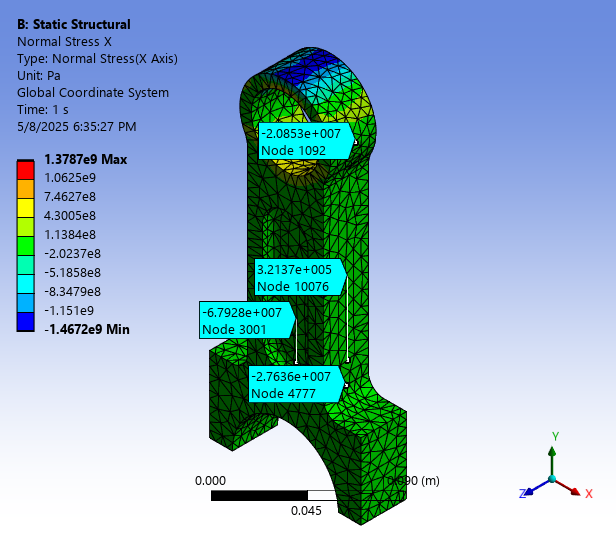
As part of my Internal Combustion Engines course, I designed a piston connecting rod, developing parametric stress models and performing fatigue analysis under cyclic loading to guide design decisions. I wrote Python scripts to compute stresses across the full loading cycle at high resolution, enabling rapid iteration of key design parameters. The finalized geometry was modeled in Fusion 360 and exported to ANSYS for finite element stress analysis, where simulation results were compared against analytical predictions to inform stress model refinements.
Read more >>>

Robot Arm Modeling and Simulation

Robot Arm Modeling and Simulation icon

Robot Arm Modeling and Simulation

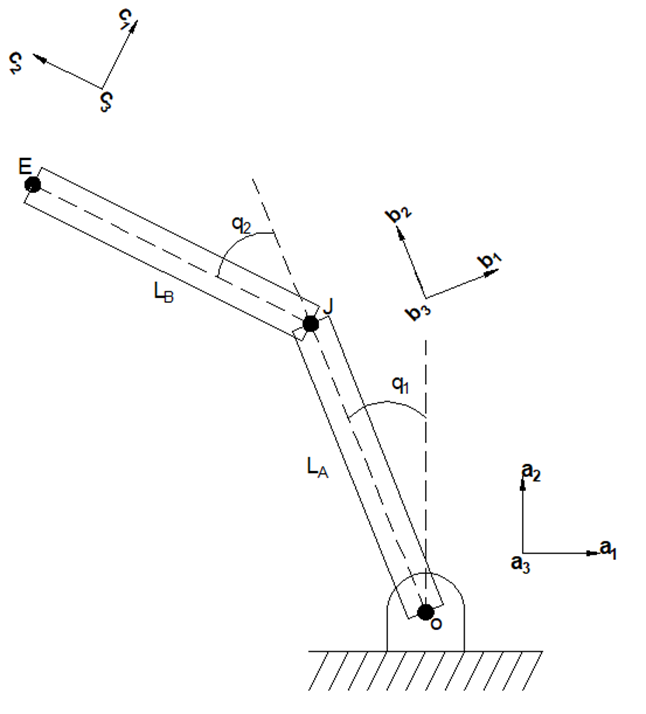
For a class on Modeling and Simulation, I worked with a partner to model and simulate a two-link, 2D robot arm with AutoLev and MATLAB. We later wrote and published a technical paper in the ASME IMECE on this project, discussing how our work could inform the design of baseball-pitching robot arms.
Read more >>>

Spherical Fluid Pulsation Dampener

Spherical Fluid Pulsation Dampener icon

Spherical Fluid Pulsation Dampener

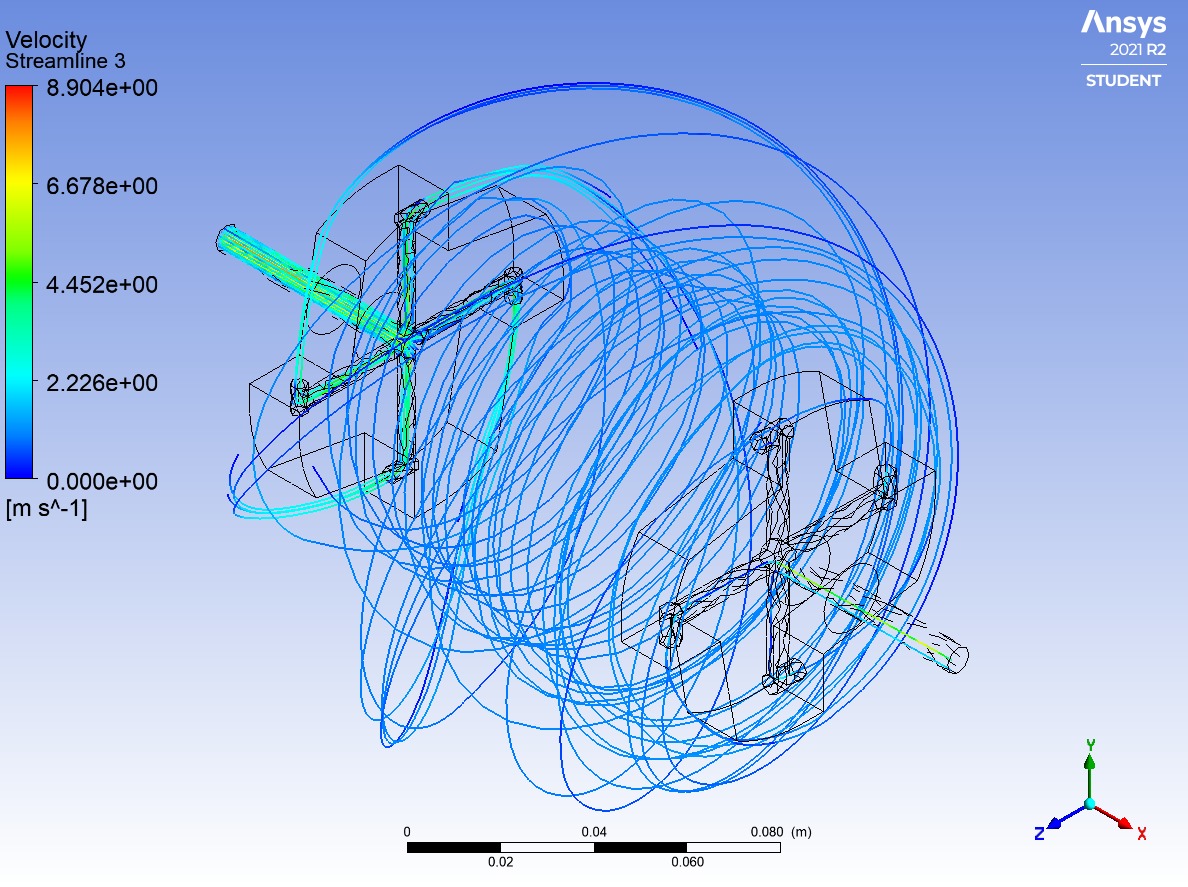
For my Capstone Project, I collaborated with a partner to design and prototype a spherical fluid pulsation dampener demonstrating a passive, no-moving-parts fluid dampening concept based on prior research. I was responsible for modeling the components and producing detailed 2D engineering drawings in Autodesk Inventor, applying GD&T standards to communicate the design. I extracted the internal fluid volume from the assembly for CFD analysis in ANSYS Fluent, where simulation results verified the vortex formation required for effective pulsation dampening. After evaluating machining and additive manufacturing options, we selected 3D printing to meet a $500 budget constraint. Performance was validated by designing and building a custom test apparatus using pressure transducers and a Raspberry Pi to measure inlet and outlet pressure response.
Read more >>>